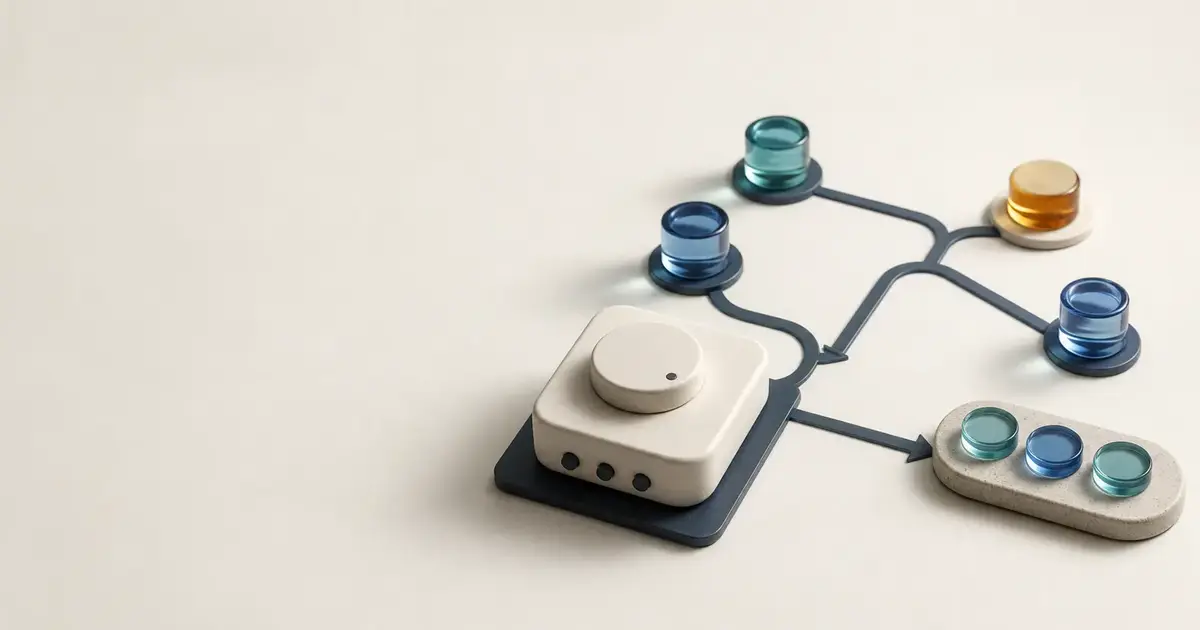
An LLM is a large language model that produces text or structured requests from an input. That output is harmless while it stays in a chat box. The risk changes when the model can run a shell command, install a package, edit a repository, or send a request to an outside service.
Consider a dependency update. The agent edits the manifest, runs the tests, sees a failure, changes an import, and runs the tests again. The product needs the second attempt to see the first attempt’s files. It also needs to show a reviewer the failed test rather than only the agent’s final claim that the update worked.
An LLM sandbox environment is the isolated machine and policy boundary where that work runs. An agent runtime is the software that starts the agent, controls its tools, manages its session, and records the result. A side effect is a change outside the model’s text, such as a file edit, process, network request, or database write. A trace is the record of the inputs, actions, tool events, outputs, and failures from the run.
Tangle Sandbox provides a public software development kit (SDK) for creating a machine, running commands, dispatching an agent prompt, reconnecting to a durable session, and deleting the machine. The SDK is the starting boundary. The application still has to decide which tools, files, credentials, network routes, and acceptance checks belong inside it.
A sandbox limits where an agent can act and preserves what happened. It does not decide whether the action was correct.
Put the side effect behind a boundary
Before the first tool call, answer five questions.
| Question | Example answer for a dependency update |
|---|---|
| What can run? | Node commands from an approved image |
| What can be changed? | Files under the disposable workspace |
| What can leave? | Package registry traffic, without the repository token |
| What is recorded? | Commands, exit codes, output, file changes, and session events |
| What survives cleanup? | The review packet and optional snapshot, not the temporary machine |
The answers should be enforced by the service that starts and controls the environment. A prompt can tell the model to stay inside a directory. The runtime must make another directory unavailable or reject a write outside the policy.
There are two boundaries to keep separate.
The first is machine isolation. Firecracker documents microVM isolation. The Open Container Initiative runtime specification describes a standard container runtime interface.
The second is application policy. It decides which image, command, network destination, credential, lifetime, and artifact rules apply to this run. Machine isolation without policy can still give an agent a broad network and a broadly scoped credential. Policy without machine isolation can still leave the host exposed to a bad command.
Create, act, reconnect, delete
The current Tangle quickstart installs the public package and passes the API key explicitly to the client.
npm install @tangle-network/sandbox
export TANGLE_API_KEY=sk-tan-...
The following example uses the current public client methods for a short command run:
import { Sandbox } from '@tangle-network/sandbox'

const client = new Sandbox({
  apiKey: process.env.TANGLE_API_KEY!,
  baseUrl: process.env.SANDBOX_BASE_URL ?? 'https://sandbox.tangle.tools',
})

const box = await client.create({
  name: 'dependency-review',
  image: 'node:20',
  backend: { type: 'opencode' },
  resources: {
    cpuCores: 2,
    memoryMB: 4096,
    diskGB: 20,
  },
  maxLifetimeSeconds: 1800,
  idleTimeoutSeconds: 900,
})

try {
  const before = await box.exec('node --version')
  const tests = await box.exec('npm test', {
    cwd: '/workspace',
    timeoutMs: 60000,
  })

  console.log({
    node: before.stdout,
    testExitCode: tests.exitCode,
    testOutput: tests.stdout,
    testError: tests.stderr,
  })
} finally {
  await box.delete()
}
The Sandbox client and methods in this example are documented in the public quickstart and SDK reference. The example is a server-side call. Do not place the API key in browser JavaScript.
The first command and the test command share the same machine. If the test fails, the process output and the files it changed can remain available for the next action before cleanup. The cleanup block makes deletion happen when the command throws as well as when it succeeds.
That lifecycle is more useful than a generic success string. It gives the application an exit code, output, and a point at which it can choose to retry, ask for review, or stop.
A stream needs a durable identity
A request-response call is enough for a short command. An agent task can outlive the client that started it. The browser can reload. The API worker can deploy. The laptop can lose its network.
The SDK reference separates an ordinary prompt stream from a durable session. Dispatch the prompt with a server-derived session identifier, then reconnect to that session from another process.
const { sessionId, alreadyExisted } = await box.dispatchPrompt(
  'Inspect the failing test and explain the smallest safe fix.',
  { sessionId: serverDerivedSessionId },
)

console.log({ sessionId, alreadyExisted })

for await (const event of box.session(sessionId).events()) {
  console.log(event)
}

const result = await box.session(sessionId).result()
const status = await box.session(sessionId).status()
console.log({ result, status })
The same session identifier is idempotent in the current SDK. If the caller repeats the dispatch, the service returns the in-flight or completed session instead of executing the prompt twice. That behavior matters for retries triggered by webhooks, payments, or browser reconnects.
Idempotency does not mean the task is correct. It means the product can retry the request without silently duplicating the side effect. The trace must still say whether the command ran, whether the model changed files, and whether the final check passed.
Classify side effects before allowing tools
Not every tool deserves the same approval path. Reading a file, changing a disposable workspace, publishing a package, and deleting a customer record are all side effects, but their recovery costs are different.
| Side-effect class | Example | Default treatment |
|---|---|---|
| Read-only | Inspect a file or run a version command | Allow inside the workspace and record the request |
| Reversible workspace write | Edit a source file before review | Allow in an isolated workspace and retain the diff |
| External reversible action | Open a draft pull request or create a staging object | Require a scoped credential and an explicit target |
| Durable external action | Send an email or publish a package | Require a review or approval event before execution |
| Irreversible action | Delete a record or move funds | Keep outside the default agent tool set or require a separate human-controlled operation |
The classification is about the effect, not the command name.
npm install may look like a local command, but a lifecycle script can execute code and a package download can leave the workspace.
curl may read public metadata or send a credential to an external service.
The runtime should inspect the destination, credential, and resulting artifact rather than trust a friendly tool label.
This policy also affects the trace. A rejected durable action should be recorded as rejected, not omitted. A workspace edit should include the changed file or diff reference. An external request should include the target identity without leaking the credential used to authorize it. The reviewer needs to know whether the agent proposed an action, attempted it, or completed it.
Start by listing the side effects the product truly needs. For every tool, name the resource it can touch, the credential it receives, the maximum lifetime of that authority, and the evidence produced when it runs. If a tool cannot answer those questions, it is not ready for an autonomous sandbox run.
Capture the run at the point of action
A useful trace has enough detail to separate a proposal from an action.
| Event | What it establishes |
|---|---|
| Prompt received | What task the agent was asked to perform |
| Command requested | Which action the agent attempted |
| Command result | Exit code, output, error, and timeout state |
| File change | Which artifact changed and when |
| Session reconnect | Which client resumed the same run |
| Evaluation result | Whether a declared check passed |
| Review decision | Whether a person or product accepted the result |
The record should not claim more than its source provides. A model message saying “tests passed” is not a test result. A command request is not a command completion. A file diff is not proof that the application works.
An evaluation is a structured assessment against a criterion. For the dependency update, the criterion might be that the test command exits zero and the lockfile contains the intended version. A baseline is the current implementation or result used for comparison. A candidate is the proposed change being tested. Those terms become important when many sandbox runs compare prompts, models, tools, or code versions.
The Tangle AI documentation describes Intelligence as the product that receives run traces and supports evaluation of agent behavior. The sandbox records what ran. The evaluator decides what the record means for the task.
Default to narrow authority
Start with the smallest environment that can complete the task.
| Capability | Starting policy |
|---|---|
| Shell | Allow only the commands the workflow needs and enforce a timeout |
| Filesystem | Give the run a separate workspace and exclude host directories |
| Network | Allow required package or service destinations explicitly |
| Credentials | Use short-lived, scoped secrets and keep them out of artifacts |
| Packages | Pin or inspect dependencies before installation |
| Long tasks | Stream events and store them under a stable session |
| Cleanup | Delete the machine unless a reviewed snapshot or artifact is required |
The policy should fail closed. If the service cannot determine whether a command is allowed, stop and ask for a policy decision. If a credential cannot be scoped, do not pass it to the agent. If a task loses its session identity, do not start a second copy to “see whether it works.”
These defaults do not prevent every attack. An allowed package registry can serve a malicious dependency. An allowed API token can still grant too much access. A model can use an allowed command for an unintended purpose. The policy reduces blast radius and makes the action inspectable.
Recovery is part of the product
A good sandbox workflow preserves the failed step rather than resetting it away.
Suppose the dependency update produces this sequence:
1. npm install -> package manifest changed
2. npm test -> exit code 1, one import failed
3. agent edits the import
4. npm test -> exit code 0
5. reviewer inspects diff and test output
The second test result is more useful because the first failure remains attached to the same session and workspace. The reviewer can see why the edit happened. If the agent starts a fresh machine at step three, the product loses evidence about the failed hypothesis.
Snapshots can help when a task needs to resume from a known filesystem state. The current SDK reference documents restoring a sandbox from a snapshot and stopping or resuming a machine. Use those features deliberately. Do not assume that deleting a sandbox preserves its files. Copy the diff, logs, and review packet to durable storage before cleanup.
Model retries are not operational retries
The same prompt can be safe to dispatch twice when the session identifier makes the dispatch idempotent. The same command can still be unsafe to run twice. Installing a package twice may be harmless in one project and invoke a different lifecycle script in another. Sending an email, creating a payment, or applying a migration can duplicate a real-world effect even when the model says it is retrying.
The runtime should classify retries at the action boundary:
| Retry target | Check before repeating |
|---|---|
| Session dispatch | Does the server already know this session identifier? |
| Read-only command | Is the workspace and target still the expected one? |
| File edit | Does the current file match the base used for the proposed patch? |
| Test command | Did the previous process finish, or is it still running? |
| External write | Does the service expose an idempotency key or a lookup by request identity? |
| Cleanup | Is the machine already deleted, or does the deletion need another attempt? |
This is why a reconnect flow should inspect state before creating a new worker. The product may have lost the response, not the work. Starting a second agent to recover a missing response can create two competing edits or two external requests.
When an operation cannot be made idempotent, make the retry a review decision. Show the last known request, target, and result state to a person or a policy service. Unknown is safer than a second side effect whose first outcome was merely not observed.
When a sandbox becomes a service
An LLM sandbox can be a product boundary by itself. It can also sit inside a service offered to other applications. Tangle uses several terms for that larger path.
A Blueprint is a reusable service template with a job interface and execution requirements. A service instance is one live deployment of that template. An operator is the compute provider that runs a service instance. The Tangle core concepts define those terms.
A router is the model-access layer that selects or forwards an inference request. It can provide one request shape over several providers. It does not make a tool call safe or make a sandbox policy complete.
x402 is an HTTP payment protocol for machine-to-machine requests. It can require payment before a service creates a sandbox or starts a job. Settlement proves the payment step, not the task result. The x402 project documents that payment boundary.
Attestation is cryptographic evidence about a confidential execution environment. It can help a caller check that code ran inside an expected protected machine or image. It does not prove that the model’s edit was correct. Tangle’s runtime documentation describes attestation as a prerequisite for confidential runtime activation.
The terms describe different claims:
| Claim | Evidence that can support it |
|---|---|
| The command ran in an isolated workspace | Sandbox lifecycle and runtime record |
| The service was offered through a reusable interface | Blueprint definition and service instance |
| A compute provider ran the instance | Operator record |
| The protected machine matched an expected identity | Attestation evidence |
| The HTTP request was paid | x402 settlement |
| The result was correct | Task-specific tests, evaluation, and review |
Keeping those claims separate prevents a payment receipt or machine identity report from being mistaken for a quality result.
What a sandbox does not prove
A sandbox narrows the execution boundary. It does not make the model truthful. It does not prove that the command was the right command. It does not prove that the test suite covered the changed behavior. It does not prove that a credential could not leave through an allowed network path. It does not prove that the final diff is safe to merge.
The reviewer needs a recovery path for each of those limits. That can be a rejected command, a redacted artifact, a failed evaluation, an approval step, or a request to rerun with narrower authority.
The AI dev container guide focuses on the production control plane around this boundary. The AI agent sandbox guide shows the smaller create, execute, inspect, and delete workflow.
Choose the boundary that matches the side effect
Use plain chat when the model only drafts text and cannot change external state. Use a one-shot code runner when the input and output are fixed and no workspace needs to survive. Use an LLM sandbox environment when the model can run commands, edit files, use credentials, or recover from an intermediate result. Use a larger service boundary when the task needs payments, operators, confidential execution, or a reusable job interface.
Start with one disposable task. Create the workspace, run one safe command, force one failure, reconnect to the same session, inspect the trace and file state, and delete the machine. If the team cannot explain that sequence, more autonomy will make the system harder to review.
What is an LLM sandbox environment?
It is an isolated runtime where an LLM-powered agent can execute tools, run commands, edit files, and preserve evidence about those actions.
Why not run the agent directly on my server?
Direct execution mixes model behavior with production state. A sandbox gives the run a separate machine or container, explicit permissions, a lifecycle, and a record that can survive the client.
Does a sandbox prevent every security issue?
No. It reduces the area a mistake can affect. Security still depends on image provenance, credential scope, network policy, command limits, artifact handling, and the application around the sandbox.
How does Tangle Sandbox fit?
The public SDK supplies the machine and session boundary. Tangle’s other products can add model routing, traces, evaluation, or paid service execution. Each added layer has its own proof and failure modes.
Should I keep the sandbox after a run?
Keep it only when a reviewed snapshot or later step needs the same filesystem. Otherwise, copy the evidence you need and delete the temporary machine.